
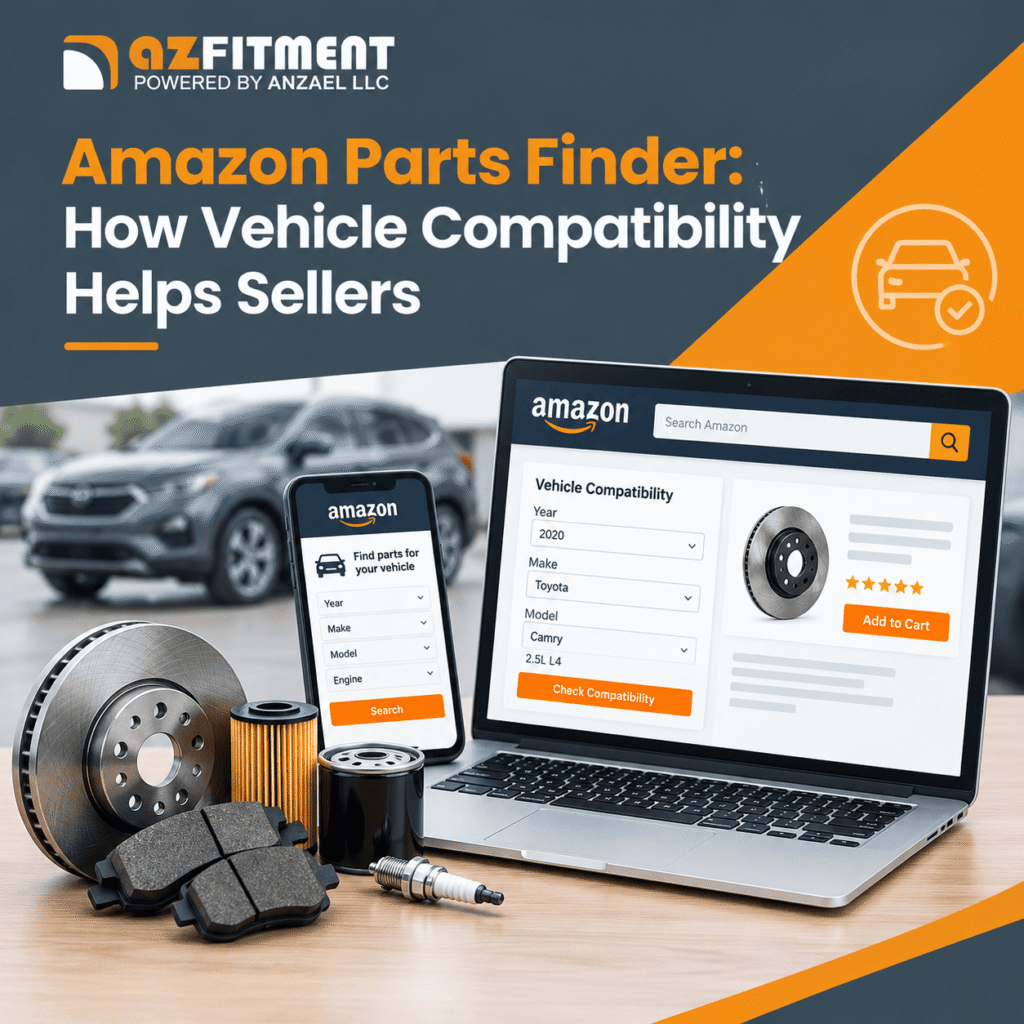
Selling auto parts on Amazon involves more than creating product titles, uploading images, and setting competitive prices. Customers also need to know one critical thing before placing an order: Will this part fit my vehicle? This is where the Amazon Parts Finder and accurate vehicle compatibility data become important.
For automotive sellers, accurate fitment information connects the right part with the right vehicle application. Amazon’s automotive fitment functionality allows shoppers to check whether a product is compatible with their selected vehicle, while sellers can use structured fitment data to improve listing accuracy and the overall buying experience.
What Is an Amazon Parts Finder?
An Amazon Parts Finder is a vehicle-based search and compatibility experience that helps customers identify automotive products that match their vehicle. Instead of relying only on a generic product description, shoppers can select vehicle information and determine whether a particular part is intended for that application.
For auto parts sellers, this means vehicle compatibility data becomes an important part of product information. Details such as year, make, model, engine, part number, brand, and vehicle application can help establish the relationship between a product and the vehicles it fits.
The goal is simple: help shoppers find a part that is appropriate for their vehicle before they purchase it.
Why Amazon Parts Finder Fitment Matters
Automotive products often look similar even when their applications are different. Two brake components, filters, sensors, suspension parts, or ignition components may have similar descriptions but fit different vehicle configurations.
This makes Amazon Parts Finder fitment particularly valuable. When compatibility information is accurate, customers have more confidence that the product they are considering matches their vehicle.
For sellers, better fitment information can help:
- Reduce incorrect product orders
- Minimize fitment-related returns
- Improve customer confidence
- Make large automotive catalogs easier to manage
- Connect products with more relevant vehicle applications
- Provide a better shopping experience
azFitment states that accurate fitment data can help sellers reduce returns and improve the customer experience, while its platform is designed to manage and submit vehicle fitment information across Amazon and other ecommerce platforms.
How Amazon Parts Finder Vehicle Compatibility Works
At the foundation of the Amazon Parts Finder vehicle compatibility experience is structured application data.
A seller needs to establish which vehicles a particular part fits. Depending on the product, this can involve vehicle year, make, model, engine, part number, brand, and other application information.
For example, consider an automotive sensor designed for a specific vehicle configuration. If the seller associates that product with the correct vehicle applications, a customer searching for parts for that vehicle has a better chance of seeing an appropriate product.
The quality of the result depends heavily on the quality of the underlying fitment data. Incorrect applications, missing vehicles, outdated information, or incorrect part-number mappings can create problems even when the product itself is correct.
The Role of ACES and Vehicle Fitment Data
Managing fitment manually becomes increasingly difficult as an automotive catalog grows. A seller may have thousands of products, each with multiple vehicle applications.
Industry-standard data can make this information easier to organize and maintain. azFitment supports fitment data management based on ACES standards and helps sellers prepare compatibility information for Amazon automotive listings.
Using structured Amazon vehicle fitment data gives sellers a more systematic way to associate parts with compatible applications rather than maintaining disconnected spreadsheets or manually updating individual listings.
This is especially useful for manufacturers, distributors, and aftermarket sellers managing large catalogs.
Common Amazon Fitment Problems Sellers Face
Even when a seller has good products, inaccurate compatibility information can create unnecessary friction.
Common issues include:
Incorrect vehicle applications: A product may accidentally be associated with a vehicle it does not fit.
Incomplete fitment: Some compatible vehicle applications may be missing from the catalog.
Incorrect part-number mapping: Product and manufacturer part numbers need to be associated correctly with marketplace listings.
Outdated data: Vehicle tables and marketplace requirements can change, requiring sellers to review and update their information.
Listing configuration problems: Missing ASIN mapping, incorrect categories, or incomplete fitment information can affect how compatibility information is displayed.
These problems demonstrate why Amazon auto parts fitment should be treated as an ongoing data-management process rather than a one-time listing task.
How Sellers Can Improve Amazon Parts Finder Accuracy
Start by maintaining a reliable master product catalog. Each part should have accurate product identifiers and clearly defined vehicle applications.
Next, validate the relationship between the part and each vehicle application. Pay particular attention to year, make, model, engine, and other configuration differences.
Sellers should also monitor marketplace changes and regularly update their fitment information. According to azFitment, Amazon automotive tables are updated regularly, and changes can affect existing fitment data.
Finally, consider using a centralized fitment management platform when the catalog becomes too large to maintain efficiently. A centralized system can make it easier to update data and distribute current fitment information to marketplace and eCommerce channels.
Why Vehicle Compatibility Can Support Amazon Sales
A customer buying an automotive component wants confidence before completing the transaction. A clear compatibility experience can remove uncertainty and make it easier for the shopper to decide.
Accurate Amazon Parts Finder data does not replace strong product content, competitive pricing, quality images, or reviews. Instead, it complements these elements by addressing one of the most important questions in automotive eCommerce: Does this part fit my vehicle?
For sellers with extensive catalogs, managing vehicle compatibility accurately can also create operational benefits. Better-organized fitment data makes it easier to maintain products, identify errors, update applications, and distribute information across eCommerce channels.
Final Thoughts
The Amazon Parts Finder is more than a vehicle lookup feature. For automotive sellers, it represents an important connection between product data, vehicle compatibility, and the customer’s purchase decision.
By maintaining accurate amazon parts finder fitment, structured vehicle applications, correct part-number mappings, and current compatibility information, sellers can create a more reliable buying experience and reduce fitment-related problems.
As automotive eCommerce becomes increasingly data-driven, investing in accurate vehicle compatibility information can help sellers manage larger catalogs while making it easier for customers to find the right parts for their vehicles.
FAQs:
Amazon Parts Finder is an automotive compatibility experience that helps shoppers determine whether an auto part is suitable for their selected vehicle. It relies on vehicle and product fitment information to connect compatible parts with specific vehicle applications.
Amazon Parts Finder can help customers verify compatibility before purchasing. Accurate fitment information can improve buyer confidence, reduce incorrect orders, and create a better shopping experience.
Amazon Parts Finder fitment refers to the vehicle application information that connects an automotive product with the vehicles it is designed to fit. This can include year, make, model, engine, and other relevant application information.
Depending on the product and marketplace requirements, sellers may need brand information, manufacturer part numbers, ASIN details, and vehicle application data such as year, make, model, and engine.
It allows customers to check whether an automotive product is compatible with their vehicle before purchasing. This can reduce uncertainty and help shoppers select more appropriate products.
ACES is an industry-standard format used to structure automotive application and fitment information. azFitment supports fitment data management based on ACES standards for Amazon automotive listings
Accurate fitment data can help reduce incorrect purchases caused by compatibility errors. It does not eliminate all returns, but providing correct vehicle application information can help minimize fitment-related returns.
Incorrect part-number mapping, incomplete vehicle applications, outdated fitment data, category issues, ASIN mapping problems, or other listing configuration issues can affect fitment information.
Yes. Automotive manufacturers, distributors, and sellers with large catalogs can use centralized fitment management systems to organize vehicle applications and maintain compatibility information at scale. azFitment is designed to support large automotive catalogs.
Sellers should maintain accurate product identifiers, validate vehicle applications, keep fitment data current, monitor marketplace changes, and use structured fitment management processes. Regularly reviewing Amazon compatibility information can help identify and correct potential errors.
