
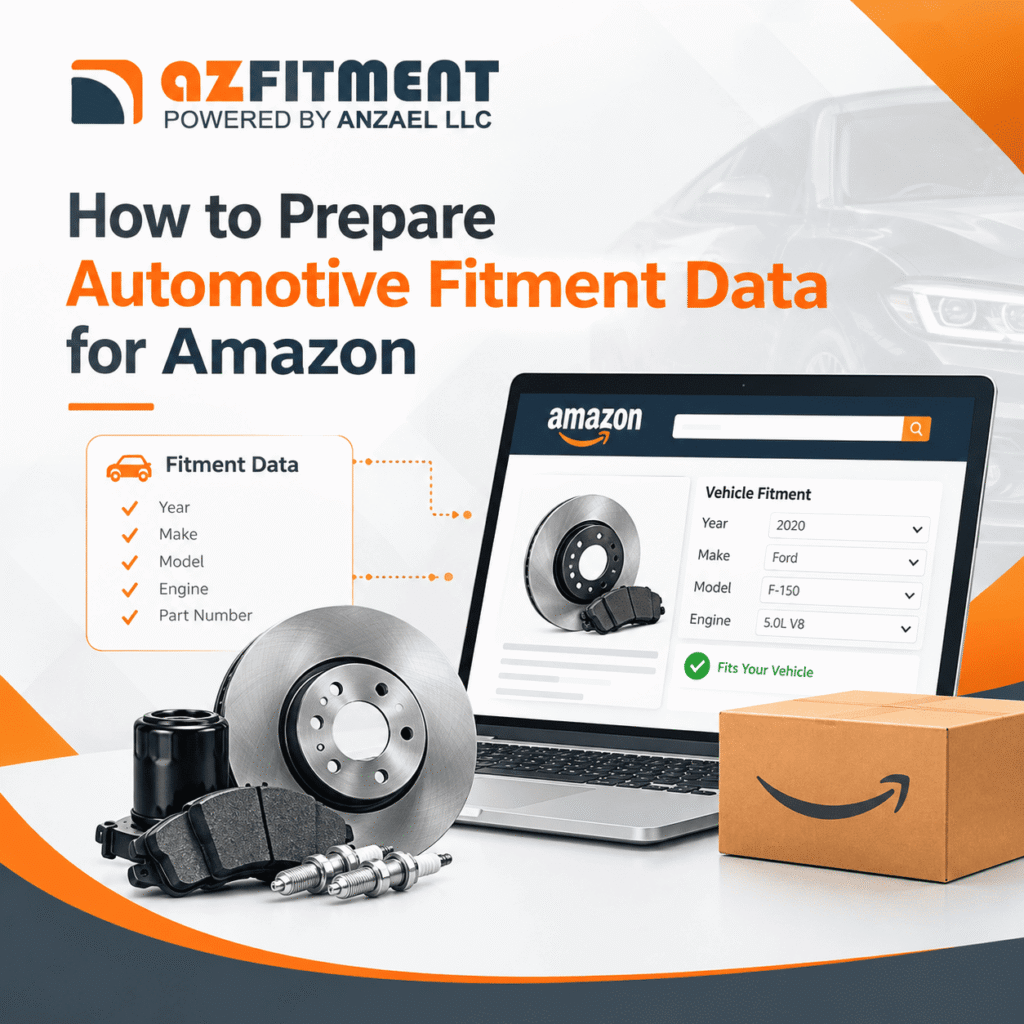
Selling auto parts on Amazon requires more than uploading product images, descriptions, prices, and inventory. Customers also need to know whether a specific part is compatible with their vehicle. This is where accurate Automotive Fitment Data for Amazon becomes essential.
Fitment data connects an automotive part with the vehicles it is designed to fit, typically using information such as year, make, model, engine, and other vehicle-specific attributes. Amazon uses vehicle compatibility information to help shoppers identify suitable automotive products.
For auto parts manufacturers, distributors, and sellers, preparing accurate Amazon fitment data can improve listing accuracy, make vehicle-based product discovery easier, and reduce compatibility-related purchasing mistakes. Here is a practical process for preparing your data before submitting it to Amazon.
What Is Automotive Fitment Data for Amazon?
Automotive fitment data for Amazon is the compatibility information that connects a specific automotive product or part number to the vehicles where it can be used.
A basic fitment record may include:
- Year
- Make
- Model
- Engine
- Part number
- Brand
- Vehicle-specific application information
For example, instead of simply listing a brake component as compatible with “Ford vehicles,” detailed amazon automotive fitment can identify the applicable year, make, model, and engine combinations.
This level of detail gives customers greater confidence when searching for replacement parts online.
Step 1: Organize Your Product and Part Numbers
Start with a clean master product list. Every product should have a unique part number, brand, product description, and other relevant catalog information.
Check your data for:
- Duplicate part numbers
- Incorrect brand names
- Missing part numbers
- Inconsistent formatting
- Outdated product information
Part-number accuracy is particularly important because compatibility information must ultimately connect to the correct product.
Step 2: Build Accurate Vehicle Applications
The next step is to identify the vehicles each part actually fits.
Do not rely only on a broad vehicle description. Build specific applications using available vehicle attributes such as year, make, model, and engine.
Accurate Amazon vehicle fitment data should represent the actual application of the product rather than simply adding every vehicle that appears similar.
This is also where sellers should identify coverage gaps. Missing a valid vehicle application can prevent potential customers from finding a compatible product, while adding an incorrect application can create customer confusion and returns.
Step 3: Validate Your Fitment Data
Before submitting your data, validate every application.
Common fitment problems include incorrect part numbers, incomplete vehicle coverage, outdated applications, and mismatched vehicle details. azFitment’s existing guidance also highlights the importance of keeping fitment information current because automotive standards and vehicle applications can change.
A validation process should check:
- Part number accuracy
- Brand consistency
- Vehicle application accuracy
- Duplicate records
- Missing information
- Unsupported or outdated applications
The goal is simple: every vehicle application should have a clear relationship with the part being sold.
Step 4: Prepare Data for Amazon Submission
Once your fitment information has been created and validated, prepare it according to Amazon’s required process and identifiers.
One important consideration is brand identification. azFitment notes that sellers need a registered brand code before they can submit fitment to Amazon.
Depending on your catalog size, manually maintaining these records can become difficult. A dedicated fitment management platform can help organize, validate, update, and distribute compatibility data from a centralized system.
Step 5: Keep Amazon Fitment Data Updated
Fitment is not a one-time task.
Vehicle applications, industry data, product catalogs, and marketplace requirements can change. azFitment recommends ongoing management rather than a “fit and forget” approach.
Regular updates can help you identify new vehicle applications, correct existing records, and maintain better catalog accuracy.
This is particularly important for sellers managing hundreds or thousands of SKUs.
Why Accurate Amazon Fitment Data Matters
Accurate fitment data helps customers determine whether a product is suitable for their vehicle before purchasing. That can improve confidence and reduce compatibility-related problems.
For sellers, better data management can also make it easier to maintain automotive catalogs across multiple channels. azFitment supports fitment management and distribution for Amazon, eBay, Walmart, Shopify, BigCommerce, WooCommerce, and other channels.
Instead of maintaining completely separate compatibility databases for every marketplace, businesses can use a centralized approach and adapt the data for different channels.
Manage Automotive Fitment Data More Efficiently
Preparing automotive fitment data for Amazon requires more than entering Year, Make, and Model. Sellers need accurate product information, detailed vehicle applications, validation, proper marketplace preparation, and regular updates.
azFitment provides tools for creating, managing, validating, and distributing vehicle fitment data. Its Amazon solution also provides vehicle lookup, data validation, fitment management, and supported data export capabilities.
For businesses with a growing automotive catalog, a structured fitment management process can make compatibility data easier to maintain while helping customers find the right parts for their vehicles.
If your business sells automotive products on Amazon, keeping your Amazon fitment data, Amazon automotive fitment, and Amazon vehicle fitment data accurate should be an ongoing part of your eCommerce catalog strategy.
FAQs:
Automotive fitment data identifies the vehicles that a particular automotive part is compatible with. It commonly includes vehicle year, make, model, engine, and related application information.
Accurate Amazon fitment data helps customers identify whether a part is compatible with their vehicle. Better compatibility information can reduce purchasing confusion and fitment-related returns.
The exact requirements depend on the product and Amazon’s current processes, but vehicle application information generally includes year, make, model, engine, and the relevant product or part number.
Start with a clean product catalog, identify the correct vehicle applications, validate part numbers and vehicle information, prepare the data according to Amazon’s requirements, and regularly update the applications.
azFitment states that a registered brand code is required before fitment can be submitted to Amazon. Sellers should verify their current Amazon and industry requirements before submission.
Fitment should be treated as an ongoing data-management process rather than a one-time upload. Vehicle applications and industry data can change, so regular validation and updates are recommended.
Yes. A centralized fitment management system can help businesses manage compatibility information and distribute it across supported marketplaces. azFitment supports Amazon, eBay, Walmart, Shopify, BigCommerce, and WooCommerce.
Common issues include incorrect part numbers, wrong vehicle applications, incomplete vehicle coverage, duplicate records, inconsistent brand information, and outdated fitment data.
Yes. azFitment provides tools for creating, managing, validating, and distributing vehicle fitment data, including functionality specifically designed for Amazon.
Use a structured product catalog, validate every vehicle application, maintain consistent part and brand information, monitor data updates, and use fitment management software when your catalog becomes difficult to maintain manually.
